Keno
Generative noise subtraction for template-free gravitational-wave burst search
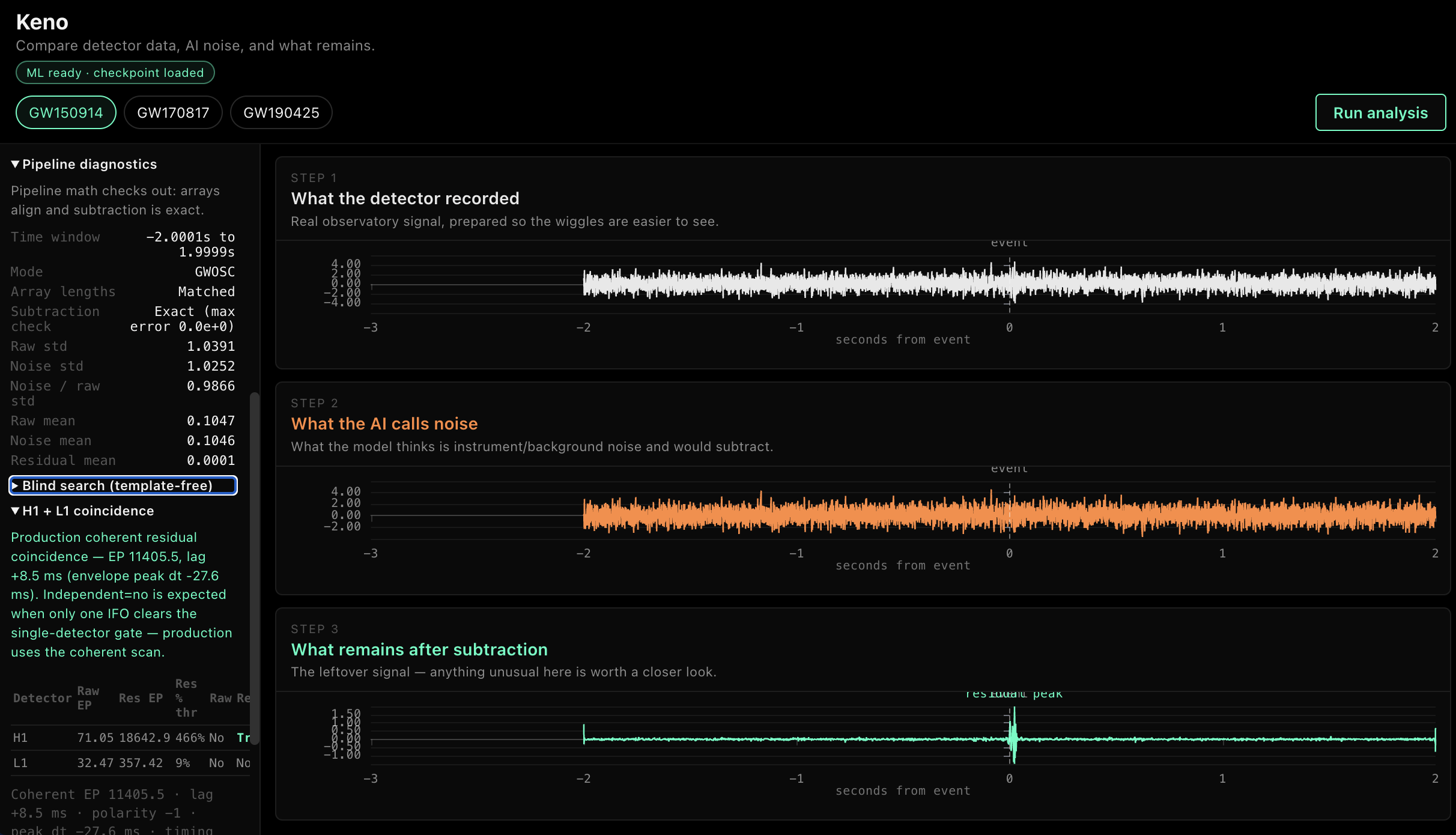
Keno is a research software prototype for searching short gravitational-wave bursts without assuming a known waveform shape. A neural network learns to predict detector noise from whitened sensor data; that prediction is subtracted; and the leftover residual is searched with an energy-based statistic, a two-detector timing check, and a simple consistency veto.
Deep dive
How it works
Generative noise subtraction
Instead of matched filtering against a known template, Keno learns what detector noise looks like and subtracts it — leaving a residual where unexpected signal energy can stand out.
- Neural network predicts noise from whitened sensor data
- Subtracted prediction yields a searchable residual stream
- Energy-based statistic with two-detector timing check
- Simple consistency veto to reject incoherent triggers
Full-stack research prototype
The project ships as a complete system — not just a model checkpoint — so results can be reproduced and explored interactively.
- PyTorch model with FastAPI inference service
- Node.js orchestration API with caching
- Angular command center for interactive residual visualization
- Documented freeze label and checkpoint for reproducibility
Evaluation highlights
Tested on synthetic bursts injected into real LIGO noise and on published catalog GPS times from GWOSC.
- ~100% detection efficiency at 1% FAR for SNR 2–12 on synthetic injections
- Wrong matched-filter template stays near ~20% on the same injections
- Residual path can trigger where raw excess power does not (e.g. GW150914)
- 9 of 18 dual-detector events recovered after glitch rejection near GW170817
Research positioning
Keno complements morphology-specific binary black hole classifiers — it is a reproducible path for unmodeled residual search, not a replacement for BBH pipelines.
- Designed for short, unmodeled burst morphologies
- Complements BBH-trained ResNet and matched-filter approaches
- Contribution is the software path: model, API, and interactive tooling
- CC BY 4.0 preprint and open-source repository
Interested in collaborating on research?
We welcome conversations about scientific software partnerships.
Get in touch